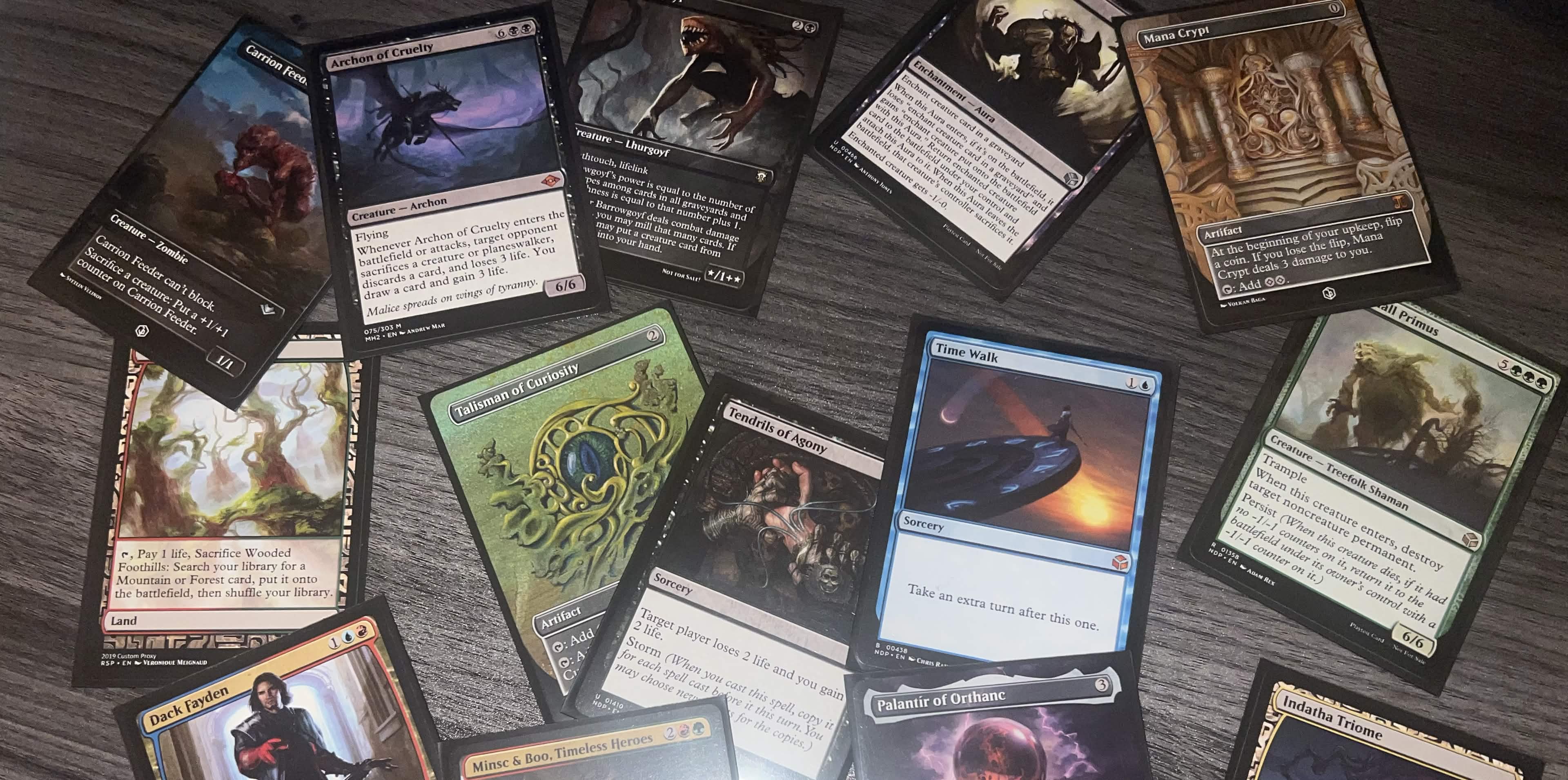
A Love Letter to the Vintage Cube
What's the Vintage Cube? ...and What's a Cube??
A Cube is a curated collection of cards — usually 360 or 540 — that you shuffle together and draft from, just like a booster draft. Instead of opening randomized packs, players build their own packs from the Cube pool and pass them around the table. The card pool is hand-selected, so every card in a Cube is there on purpose. No filler. No bulk rares. No commons that exist just to pad a set.
The MTGO Vintage Cube is the most celebrated Cube in the game. Maintained by Wizards of the Coast and updated seasonally, it's a rotating all-stars draft format built around the most powerful cards ever printed — the full Power Nine, busted combo enablers, and the best threats and answers from across Magic's entire history. Black Lotus. Ancestral Recall. Time Walk. Moxen across the board. Cards most players have never touched in a real game. It's essentially a "greatest hits" of broken Magic, designed specifically to be drafted and played in a limited context.
The online version runs on MTGO and costs tickets to enter, but the full card list is publicly available and updated regularly. Which means you can proxy it. Print the whole thing, sleeve it up, and run a draft with your friends for the cost of some cardstock and an afternoon.
That's exactly what we did — and it changed how our playgroup thinks about Magic.
Keep it Fresh
Commander groups have a rhythm problem. You build a deck, you play it for a few weeks, you retire it or upgrade it, repeat. The games blur together after a while. The same archetypes show up, the same players lean on the same strategies, and the novelty wears thin. Cube drafting breaks that cycle completely.
Every draft is a blank slate. You sit down with no deck, no plan, and no preconceptions. The first pack goes around and you make a pick. Maybe you take Tinker because it's the best card in the pack. Maybe you take a Niv-Mizzet, Parun because you think draw-go control is open. You don't know yet. The format rewards reading signals — noticing what's being passed to you, what's being cut from your right — and adjusting in real time.
Because the Vintage Cube is powered, games also play out differently than anything your Commander group has seen in a while. A turn-one Sol Ring into a Mana Vault and a three-drop is a real opener. Show and Tell putting Emrakul, the Aeons Torn into play on turn two happens. Storm decks assembling their kill by turn three while an aggro deck is still trying to stick a threat are both real, and both have legitimate answers within the format. The power level forces everyone to think about the game from a different angle.
The freshness doesn't wear off quickly either. Even players who've drafted the same Cube dozens of times still encounter hands they've never seen and board states they have to figure out from scratch. If your group doesn't use the full 540 cards for your drafts, this variance becomes even more apparent - and the times that you get both of your A+B combo become even more special.
Near Infinite Replayability
The Cube's replayability comes from two sources: the breadth of archetypes it supports, and the variance baked into the draft itself.
The Vintage Cube supports somewhere around a dozen distinct archetypes at any given time. There's a dedicated storm package — Yawgmoth's Will, Dark Ritual, Cabal Ritual, Lion's Eye Diamond — that assembles a kill through Tendrils of Agony or Brain Freeze. There's a Tinker combo shell that cheats Blightsteel Colossus or Bolas's Citadel into play. There's reanimator, using Entomb and Reanimate to put Griselbrand or Tidespout Tyrant into play as early as turn one. There's aggressive red with Goblin Guide, Eidolon of the Great Revel, and a burn package. There's control built on Force of Will, Counterspell, and card advantage engines. There's even a "powered" midrange build that just plays a lot of great cards and wins on card quality alone.
You will not draft the same deck twice. A storm deck one week becomes a Tinker shell the next because the storm pieces dried up. A control deck that wanted blue gets cut out of blue and pivots into green ramp. The signal-reading that makes draft a skill game is at its absolute height in a powered format, because the best cards are very good and the cost of being in a contested archetype is severe.
Each session is genuinely new. And when you retire a Cube night, you'll already be thinking about what you want to try next time.
Expanding Horizons
This is the part that surprised us most. Our playgroup came from Commander. Most people had decent knowledge of threats and interaction in a multiplayer context, but limited experience with the dynamics that govern 1v1 gameplay — especially at high power levels.
Cube fixed that fast.
Draft teaches you what cards actually do. In Commander, you're often jamming a 99-card singleton list that someone else built or that you optimized around a strategy you already understood. In Cube, you're evaluating cards cold, often for archetypes you haven't played before. You're asking: is Dack Fayden good because it draws cards, or because it steals artifacts, or both? What does Survival of the Fittest actually enable if I draft around it? That active evaluation builds real card knowledge faster than almost anything else.
Deck construction becomes visible. When you build a Commander deck, the 99-card constraint and singleton format let you fill gaps with mediocre cards. Cube doesn't have that padding. A 40-card draft deck built from 23 picks has to be tight — every card has to pull its weight. Players who've never thought carefully about mana curve, threat density, or the ratio of interaction to threats get exposed to those concepts immediately when the deck falls apart in testing.
The power level recalibrates your expectations. Playing against Ancestral Recall and Time Walk — even proxied — makes the dynamics of powerful Magic click in a way that reading about them doesn't. You understand viscerally why one-mana interaction is powerful. You understand what it feels like to be behind on the stack. You understand why passing with open mana matters. These are lessons that apply directly back to Commander, to constructed, to any format. Players in our group came back to their Commander decks with sharper instincts about what "good" means.
It's a great equalizer. Commander groups have power-level mismatches constantly. Someone's been tuning their combo deck for two years; someone else built their first deck last month. In a draft, everyone starts from zero. The person with the most card knowledge has an edge in the draft, but the format's inherent variance compresses the gap at the table. New players regularly steal wins because they drafted an archetype their opponents weren't prepared for. That's good for the group.
Avoid the Proxy Debate
Commander groups argue about proxies. Some groups are strict — only real cards. Some are loose — print whatever, nobody cares. Most are somewhere in the middle, and that middle ground produces friction.
Cube sidesteps the whole conversation cleanly. You're not proxying someone's personal deck. You're proxying a communal draft format that everyone plays from equally. Nobody owns the cards in the Cube — the Cube is a shared resource. That reframing changes the psychology of the table entirely.
The cost to get started is low. Print-and-play proxies on cardstock work fine for Cube, especially if you're drafting — the cards are shuffled enough that sleeves make them indistinguishable during play. The MTGO Vintage Cube list is free to look up and documented in detail. There are community tools that will generate a print sheet from the list automatically. You don't need a single real card to run a full draft.
What you do need is a willingness to try something different. For a Commander group that's been playing the same format with the same decks for months or years, that's not a hard sell once you frame it right. One draft night. Forty cards each. See what happens.